
In brief
Soil-borne organisms is a broad description of microorganisms associated with soil and plants. Their roles depend on identity, relationships, and conditions; soil origin alone does not establish safety or benefit in a formulation.
A name for life within the soil
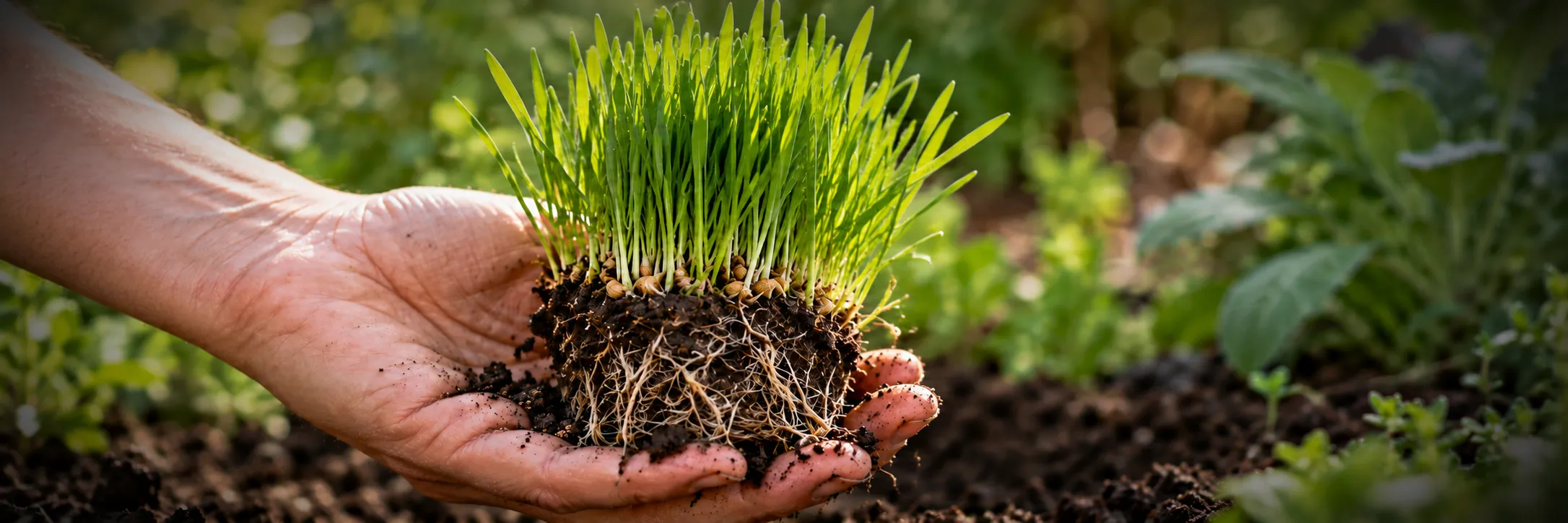
A handful of soil holds more than the material that anchors a plant. Within its small spaces, microorganisms help break down organic matter and move nutrients through the environment. Much of this activity is invisible, yet it helps shape the world we can see. 1
At Wondrous World, soil-borne organisms, or SBO, is a broad descriptive term for microorganisms associated with soil and plant ecosystems. They include many kinds of bacteria, fungi, and other microscopic life. The term describes an ecological association rather than a single species or a formal scientific group.
You may also encounter the phrase soil-based organisms. Its use varies, so neither label tells the whole story. Understanding these organisms begins with looking at what they do and the conditions in which they live.
Different roles in a shared environment
Consider what happens to a fallen leaf. As it decomposes, bacteria, fungi, and other members of the soil community take part in breaking down its material. Nutrients move through the soil food web and become available for further use. What was once part of one living thing can contribute to the growth of another. 1
Near a plant’s roots, a more direct exchange takes place. This region, called the rhizosphere, is influenced by compounds released from the roots. Microbes can use some of those compounds as food. Certain fungi form close associations with roots, receiving carbon from the plant while helping it obtain nutrients. 2
Microbes also exchange resources with one another. A substance produced by one can support the growth of another, a relationship known as cross-feeding. These exchanges exist alongside competition, and some organisms can cause plant disease. The roles within a soil community are varied; the word microbial does not describe one kind of behavior. 1, 3
Plants connect the soil with our lives
Plants make this largely unseen world relevant to everyday life. Microbial activity helps make nutrients available around their roots. Plants then become food for people and animals, connecting the conditions of the soil with the food systems we depend on. 1, 2
There is also direct contact. Farming, gardening, tending animals, and handling plants bring living systems into contact with environmental microorganisms. Fresh produce can carry microbes too. These encounters vary with place, growing conditions, food handling, and daily routines. 4
The soil–food–human connection is therefore a network of relationships. It is not a promise that a soil organism will become a lasting member of the human gut. Exposure, survival, and benefit are separate questions. This distinction lets us appreciate the connection while being precise about what it means.
Changing places change microbial contact
Soil communities respond to the habitats available to them. Tillage, crop choices, soil cover, and the presence of living roots influence that habitat. These are among the reasons soil management considers the biological community as well as the ground’s physical and chemical properties. 2
The spaces we inhabit matter as well. Research comparing homes across an urbanization gradient in South America found differences in their bacterial communities. Those findings illustrate how buildings and ways of living can shape microbial contact within particular settings. 5
This gives us a useful question to carry into the wider Journal: how do our surroundings shape our relationships with microbial life? The answer requires attention to specific environments. It also includes the benefits of clean water, safe food handling, and appropriate hygiene.
How some organisms persist
Microbial activity changes with conditions. Some organisms enter dormancy when their surroundings become unfavorable. Certain bacteria form endospores, resistant structures that can later give rise to active cells. Other organisms persist in different ways. 6
Soil association alone does not tell us which strategy an organism uses. It also does not establish survival during processing, storage, or digestion. Those properties need to be understood for the particular organism and preparation.
Selection begins with identity and purpose
When organisms are considered for a formulation, their identity and intended use become central. An organism’s role around a plant root does not establish what it will do in a person or animal. Safety and any claimed benefit require evidence relevant to the intended setting. 4
Consortia are selected communities of microorganisms. Researchers need to understand the members individually and how they behave together. Soil origin and community membership each describe something useful, but neither substitutes for that work.
What Are Living Foods? explores how WWH applies a community perspective to its category, including cultivation, the surrounding medium, and the meaning of living in a dry formulation.
Diversity becomes meaningful through function
Diversity describes variety within a community. To understand why that variety matters, we also need to ask what the community is doing. In soil, that might mean following nutrient cycling, relationships with roots, or changes after a disturbance. 1, 2
Balance is similarly tied to a setting. It does not mean that every organism occurs in equal numbers or that one ideal mixture suits every environment. A simple count of microbial types cannot tell us everything about how a system functions.
This is the perspective we bring to the word ecosystem: attention to organisms in relationship with their surroundings. It gives us a more useful starting point than assuming that the presence of more microbes always means a better result.
Continue exploring
The soil beneath a plant is a place of ongoing exchange. Learning about soil-borne organisms helps us see the distinct roles within that exchange and ask where those roles matter.
Explore Shop Living Foods for the current collection and information about individual formulations.
Sources
- [1] USDA Natural Resources Conservation Service. Soil Biology Primer. Soil food webs, decomposition, nutrient cycling, and plant relationships.
Read source - [2] USDA Natural Resources Conservation Service. Soil Health Management. Rhizosphere, root exchanges, plant diversity, soil cover, and disturbance.
Read source - [3] Yousif G et al. Obligate cross-feeding of metabolites is common in soil microbial communities. Nature Microbiology. 2026;11:2436–2447. Ecological evidence; publisher abstract and figure descriptions.
Read source - [4] ISAPP. What Qualifies as a Probiotic. Updated September 5, 2025. Microbes on fresh produce; identity, intended-use safety, and evidence of benefit.
Read source - [5] Ruiz-Calderon JF et al. Walls talk: Microbial biogeography of homes spanning urbanization. Science Advances. 2016;2:e1501061. Observational study.
Read source - [6] Mutlu A et al. Phenotypic memory in Bacillus subtilis links dormancy entry and exit by a spore quantity-quality tradeoff. Nature Communications. 2018;9:69. Organism-specific endospore research.
Read source